As Practo's design team grew from four members to a full organization of product designers, visual designers, and researchers, the need for shared principles became critical. I initiated and led a cross-functional effort to define what design excellence meant at Practo, creating a set of principles that became the decision-making framework across five business units and 4,000 employees.
Why principles
Design principles define what matters most in a product experience and serve as the primary framework for decision-making. They articulate the fundamental goals against which all design decisions can be measured, keeping the various parts of a project moving toward an integrated whole.
Good design principles:
- Force clarity by being specific
- Align teams around shared priorities
- Define the key characteristics of the product
- Enable consistency and better collaboration
The process
I organized collaborative sessions where every team member contributed candidate principles with supporting rationale. Product managers and developers were included in the ideation phase to capture perspectives from across functions. To guide the team, I shared examples from organizations in different ecosystems, asking them to think specifically about Practo's brand position: "your home for health."
Common themes were consolidated and the language refined to be colloquial and immediately understandable. For the less clear entries, I facilitated additional discussions with team members to sharpen intent and meaning.
At this stage, we had 23 unique candidate principles. Through further discussion and by applying Maslow's hierarchy as a prioritization lens, we converged on a final set that outlined the experience we wanted to create for our users.
The principles
Clear and simple
Clarity is the absence of ambiguity. It enables users to see, understand, and act with confidence. Every experience should set the right expectation and make its purpose immediately apparent.
"It seems that perfection is attained, not when there is nothing more to add, but when there is nothing more to take away."
Consistency and interplay
Internally Practo comprises many products, but for the user it is a single connected home for health. All unnecessary complexity should be removed to present clean, coherent functionality across every touchpoint.
"It is the consistency of the information that matters for a good story, not its completeness."
Be elegant, not ornamental
Practo should feel polished, simple, and purposeful. Design has a function beyond aesthetics. Every element must earn its place.
"How well we communicate is determined not by how well we say things, but how well we are understood."
Happy to help
Like a good friend, the product should always help users achieve their goals. It should know users well enough to anticipate their concerns without them voicing them. Every experience should complement their needs at every step.
"Design everything on the assumption that people are not heartless or stupid but marvelously capable, given the chance."
Trust is vital
Trust is one of the hardest things to earn from users, and one of the easiest to lose. It must be built into every product decision. Once earned, trust demands constant nurturing and attention.
"We are what we repeatedly do. Excellence, then, is not an act, but a habit."
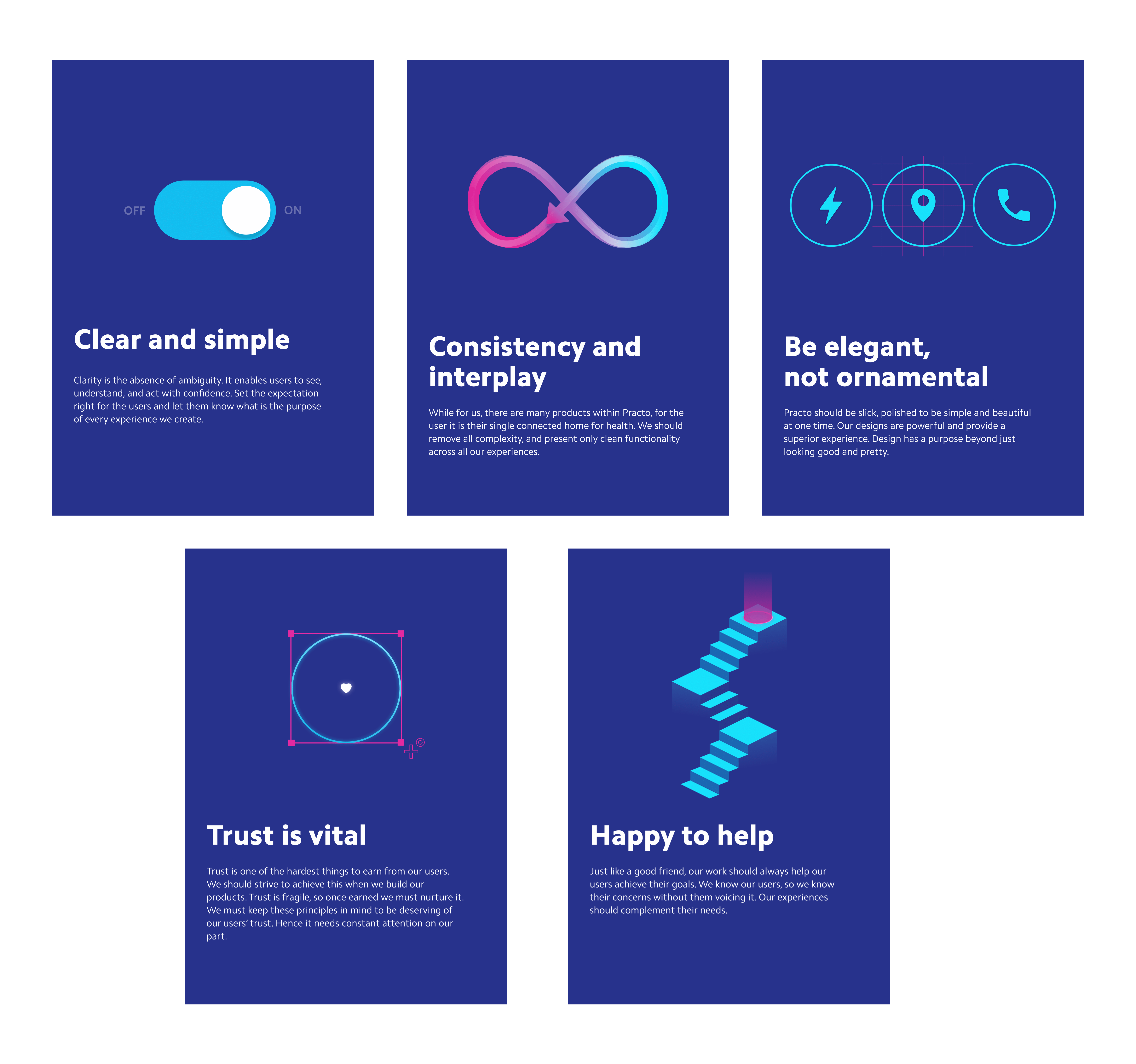
The process changed how the team approached design decisions. Posters and stickers reinforced the principles daily throughout the design bay. The framework gave the team a shared vocabulary and a clear standard for what matters most to users.